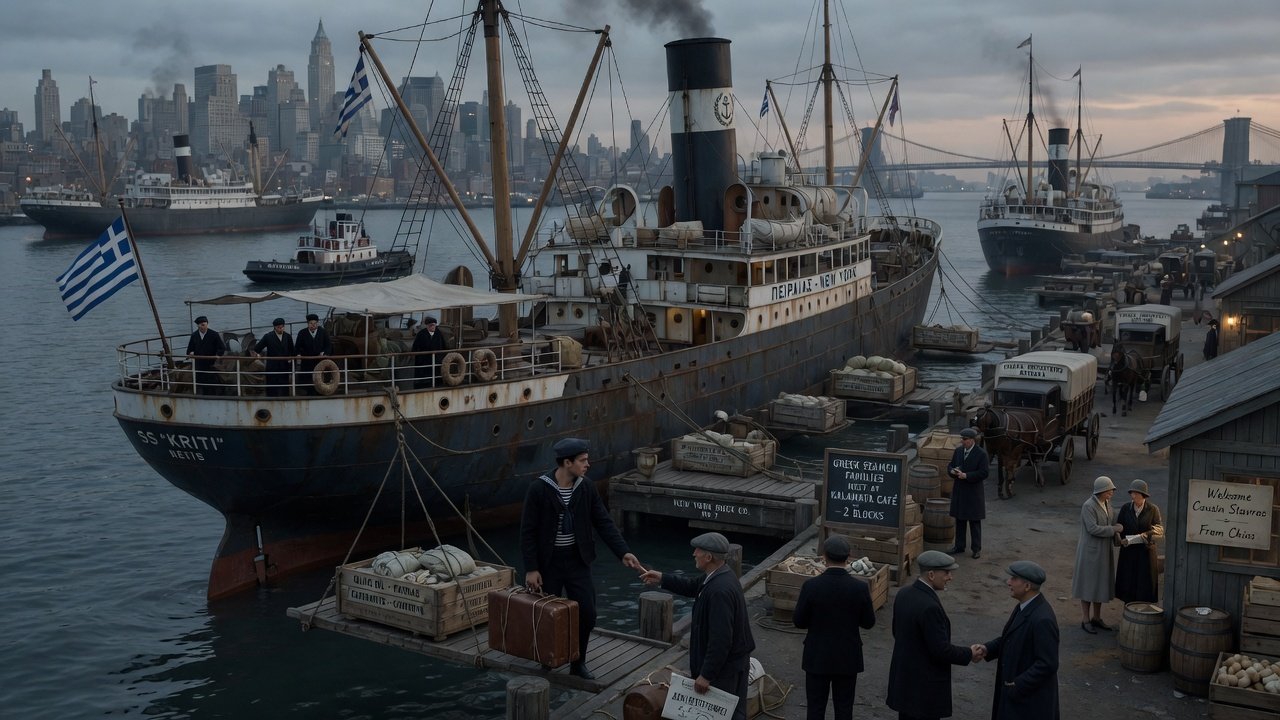
For the Greeks who arrived at Ellis Island between 1880 and 1924, the journey was difficult, the reception was hostile, and the work was brutal. But the door, at least, was open.
On May 26, 1924, the United States Congress closed it.
The Immigration Act of 1924 — known also as the Johnson-Reed Act — established a quota system based on a formula derived from the census of 1890, a year specifically chosen because it predated the mass arrival of southern and eastern Europeans. The quota for Greece was set at one hundred people per year. One hundred. In the decade before the law passed, tens of thousands of Greeks had been arriving annually. The 1924 Act did not merely slow Greek immigration. It nearly stopped it entirely, and it did so deliberately. The law's architects were explicit: they sought to preserve what they called the racial and cultural homogeneity of the United States. Greeks — along with Italians, Jews, Slavs, and others — were considered not quite white enough.
The door stayed closed for four decades.
Why the Quotas Came
The 1924 legislation was the culmination of a decade of rising nativist pressure that had been building since the peak years of immigration in the early 1900s. The same hostility that had driven Ku Klux Klan campaigns against Greek businesses in Utah, that had produced editorials warning of the dangers of the Mediterranean immigrant, that had made it difficult for Greek men to buy property in certain neighborhoods — all of it fed into a political coalition that eventually passed the most restrictive immigration law in American history.
The formula was designed, without concealment, to produce a specific outcome. By basing national quotas on the 1890 census, the law ensured that established northern European groups would receive the largest allotments, while the newer arrivals from southern and eastern Europe would be effectively barred. Greece was given a slot for one hundred people a year.
For the Greek community already in America, the law was a rupture. For the Greek communities in the islands and the mainland — in the villages of the Peloponnese, in the Cretan highlands, in the Dodecanese — it was a door slamming in the face of a future that had seemed possible.
Cuba and the Stepping Stone
The 1924 law created an immediate geography of workaround. Cuba, with its proximity to the American mainland and its relatively open immigration policy toward Europeans, became the most important staging point. In 1924, according to research by University of Alabama historian Lisa Lindquist Dorr, more than sixty thousand of the eighty-five thousand foreigners who visited Cuba that year came from the countries of southeastern Europe targeted by the American quotas. Many of them had no intention of staying in Cuba. They were waiting for a way across.
Some waited for years, learning the language, working where they could, hoping the quota system would change. Others grew impatient and took the passage across the Florida Straits, helped by networks of Greek sailors and boat captains who understood exactly what the demand was and were willing to meet it.
The Ship Jumpers
The most common method of illegal Greek entry to America after 1924 was not crossing a land border. It was arriving on a ship as a merchant sailor and simply not returning when it left port. This was called ship jumping, and in certain Greek communities it became so normalized that families discussed it openly across generations.
Elias Vlantanopoulos jumped ship in New York in 1941. He had crossed on a Greek merchant vessel, the SS Michael Livanos, and when the ship made port he walked off and did not walk back. He found work in Greek-owned businesses around the city, and right after the attack on Pearl Harbor he enlisted in the United States Army. He went on to serve in the Army Corps of Engineers, fighting in the Pacific, and he earned a Purple Heart. He nearly did not make it to the enlistment office — immigration agents raided a Greek-owned cafe he was sitting in, and he escaped through the kitchen and out the back.
He was not unusual. The SS Michael Livanos lost not just Elias but several other crew members, including its captain.
The Networks
Ship jumping did not happen in isolation. It required infrastructure. Greek sailors passed information about which ports had lighter enforcement, which employers asked fewer questions, which Greek Orthodox parishes could be trusted to help a man get on his feet without documents. The coffeehouses and restaurants of Greek neighborhoods in New York, Chicago, Pittsburgh, and Baltimore functioned, in part, as informal clearinghouses for men who had arrived by unconventional means.
Greek Orthodox churches navigated an ambiguous role. The church was the center of community life, and the community included, in many cities, a significant number of men whose immigration status was irregular. The priests who ministered to those men were not investigators. They baptized the children of ship jumpers and administered last rites to men who had lived their entire American lives without legal status and had built businesses and raised families and become, in every practical sense, American.
The xenophobia that had driven the 1924 quotas also shaped how ship jumpers were treated when caught. In one documented case, two witnesses were called to defend a Greek captain accused of helping smuggle immigrants. The prosecution, rather than cross-examining them on substance, simply asked each witness whether he was Greek and then sat down — letting the implication do the work.
AHEPA and the Long Fight
The Greek-American community's response to the 1924 law was not only individual evasion. It was also organized political resistance. The American Hellenic Educational Progressive Association, founded in 1922 partly in response to Klan campaigns against Greek immigrants, became the leading advocacy organization fighting the quota system. AHEPA's founders made a deliberate choice: the organization would conduct its business in English, would emphasize American civic participation, and would work within the political system. The assertion that Greeks could and would Americanize, on their own terms, was itself a challenge to the nativists who claimed it was impossible.
The fight took forty years. The Immigration and Nationality Act of 1965, which abolished the national-origins quota system, finally reopened the door. A second wave of Greek immigration followed — better educated, arriving in a different America, finding a Greek-American community that had been built, in part, by men who had entered through the back.
What It Meant
The ship jumpers are not a comfortable chapter of Greek-American history. They sit uneasily alongside the community's self-image as a group that worked hard and followed the rules. But the men who jumped ship in American ports after 1924 did so because the law had been constructed, deliberately, to exclude them. They arrived in the same country their predecessors had arrived in, found the same Greek parishes and coffeehouses and labor networks, and built the same kinds of lives — businesses, families, community institutions, American children.
Chris Tomaras, a Greek who jumped ship at a southern port and made his way to Chicago, told the story openly as an old man. He had gone on to build a successful business and found the PanHellenic Scholarship Foundation, which has supported generations of Greek-American students. "The laws were unjust," he said. He was not wrong.
The door that closed in 1924 was built on a theory — that certain people, by virtue of where they were born and what they looked like, did not belong in America. The men and women who found other ways in were, in their individual acts of audacity and desperation, arguing against that theory with the only evidence that mattered: their presence.
Sources: Pappas Post — "Ship Jumpers: An Unspoken Chapter of Greek Immigration to the United States" by Alexander Kitroeff; AHEPA History Archives; Lisa Lindquist Dorr, University of Alabama.