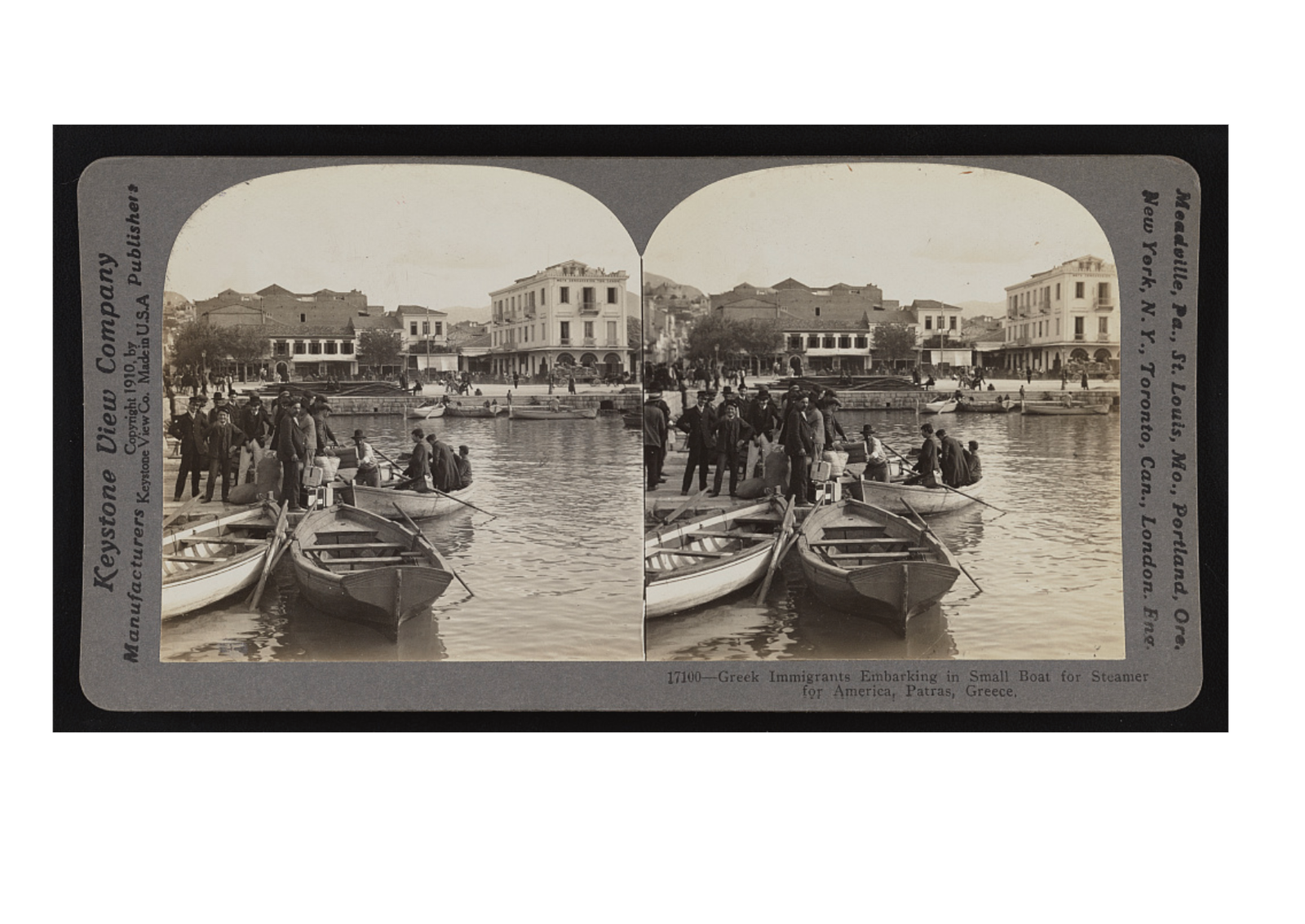
In 1879, more than eighty percent of the Greek population still lived in rural communities. The country had achieved independence from the Ottoman Empire only a generation earlier, in 1830, and had inherited from that struggle a shattered economy, an enormous foreign debt, and a political system still finding its shape. The land that Greek independence had promised was, for most Greeks, neither fertile enough nor extensive enough to support a family. And the world was changing at a pace that made Greece's agricultural economy look increasingly inadequate.
The question is not why Greeks left. The question is how they managed to leave, and why so many of them went to the same place.
The Currant Catastrophe
For much of the nineteenth century, Greece's chief export product was currants — the small dried grapes grown primarily in the Peloponnese. The currant trade sustained entire regions, and the families that grew currants had organized their lives around its rhythms and its returns. Then, in the 1890s, the price collapsed.
The cause was partly disease in the French vineyards, which had temporarily increased Greek currant exports; when French production recovered, the market contracted suddenly. Greek currant farmers who had borrowed against future harvests found themselves bankrupt, unable to pay their debts or their taxes. The collapse was concentrated in exactly the regions — the Peloponnese, the Ionian islands — that would produce the largest numbers of emigrants in the following decade.
A man who had farmed currants and now could not pay his taxes had few options. He could find other agricultural work, but there was not enough of it, and it paid badly. He could move to a Greek city, where the industrial economy was too underdeveloped to absorb him. Or he could go to America, where someone from his village had already gone and sent back a letter saying that work existed and wages were real.
The Dowry System
Greek culture imposed on families with daughters a burden that had no equivalent in the cultures of northern Europe: the proika, the dowry. A daughter could not respectably marry without her family providing substantial property — land, a house, money, linens, livestock — to the groom's family. In a society where land was the primary form of wealth and land was scarce, this meant that a family with several daughters faced a financial obligation that could consume everything it had accumulated over generations.
The obligation fell most heavily on fathers and brothers. A son who went to America and sent money home was not merely helping his family survive — he was, in many cases, providing the dowry that would allow his sisters to marry. This was understood clearly by everyone involved: the son, the sisters, the parents, and the village. It was one of the most powerful engines of emigration, because it gave even men who might otherwise have been content at home a specific, quantifiable reason to go.
The letters that Greek emigrants sent home from America frequently discussed money in exactly these terms — how much had been saved, how much had been sent, how much remained before a sister's dowry was complete. The money was not for the man's own future. It was a family obligation, measured in drachmas, working its way across the Atlantic.
Military Service and Ottoman Rule
The Greek state required three years of compulsory military service from its young men. For a peasant family already struggling, the loss of an able-bodied son for three years was a serious economic blow. And the service itself offered nothing — a peasant conscript could rarely rise above the most menial roles, and the army of a poor country fighting repeated wars along contested borders was not a comfortable institution.
For Greeks still living under Ottoman rule — in Macedonia, Thrace, and the islands that remained part of the Ottoman Empire until the Balkan Wars of 1912-1913 — the situation was more extreme. Greek youths in Ottoman-controlled territories faced conscription into the Turkish military, which many families viewed as not merely burdensome but as an existential threat to their sons' lives and identities. Emigration was, in this context, a form of resistance as well as economic calculation.
The Informational Network
Emigration, once it began, fed itself. A man who arrived in Lowell or Salt Lake City or Tarpon Springs and found work sent a letter home. The letter described the wages — low by American standards, extraordinary by Greek village standards — and the conditions, and the names of compatriots already present. The letter was read aloud in the coffeehouse and passed from household to household. It became, in effect, an advertisement.
By 1900, every village in the Peloponnese and the islands seemed to have someone in America, and every family in America seemed to have someone back in the village who was thinking about coming. The networks were dense and specific: not just "America," but "my cousin works at the Utah Copper mine and says they need men." Not just "send money," but "the crossing costs this much and you arrive at this port and ask for this person."
The Greek government, alarmed by the outflow of able-bodied men, attempted at various points to slow emigration through regulation and through Panhellenic organizations in America that encouraged men to return with their savings. The efforts had limited effect. The forces pushing emigration were stronger than the forces trying to contain it.
The America They Found
The men and women who left Greece for America between 1880 and 1924 did not find a welcoming country. They found dangerous work, low wages, hostile neighbors, and a political system that was, in those very years, debating whether people like them were white enough to belong. They found Ku Klux Klan crosses burned outside their businesses and newspapers that questioned whether they could ever be truly American.
They stayed anyway, and they built anyway, and they sent money home anyway, and eventually the villages that had sent them were sustained by what they built — and then, over time, the villages emptied as the next generation found its own reasons to go somewhere else.
What drove the Greeks out of Greece was poverty, obligation, military conscription, and the collapse of the agricultural economy. What kept them in America, once they arrived, was something harder to name: the discovery that the future they had been sent to secure was not in Greece at all, but in the country that had not quite wanted them.
Sources: EBSCO Research Starters — "Greek Immigrants"; Oregon Encyclopedia — "Greek Community in Oregon"; AHEPA History of the Order 1922-1972; Helen Zeese Papanikolas, "Toil and Rage in a New Land" (1970); Utah History Encyclopedia.