Somewhere in a village in the Peloponnese or on an Aegean island, a photograph arrived. It had been sent from America — from a Greek man working in the mines of Utah or the mills of Massachusetts or the diners of New York — and it passed through the hands of a go-between, a matchmaker, sometimes a priest, sometimes simply a trusted village elder. The photograph showed a man. It showed, sometimes, his place of work or his neighborhood. It showed very little else.
A family studied the photograph. A decision was made. A marriage was performed — in some cases, by proxy, with the groom absent and a stand-in present — and a young woman became, on paper, the wife of a man she had never seen in motion, never heard speak, never stood beside.
Then she crossed the Atlantic.
Why It Happened
The picture bride system was not unique to Greeks — it was practiced by Italians, Armenians, Germans, Japanese, Koreans, and others navigating the same fundamental problem: men had emigrated to America in enormous numbers, leaving behind villages with a lopsided demography, and those men, once they decided to stay in America rather than return to Greece, needed wives. Greek culture placed strong prohibitions on out-marriage. A Greek man in Utah or Pennsylvania was not going to marry an Irish woman or a Mormon woman if he could help it. He was going to send for a Greek woman.
From the woman's side of the transaction, the picture was more complicated. Some young women were genuinely willing — even eager. America was a place of possibility, and a photograph of a man who owned a business or wore a good suit was more promising than a life in a Greek village where the land was exhausted and the men had largely already gone. The dowry system, which required a family to provide substantial property or money with a daughter upon marriage, meant that families with limited resources sometimes had limited options. A daughter matched to a man in America solved the dowry problem.
Others were not willing at all. Stories passed from village to village about girls who arrived in America and found that the man in the photograph was older or poorer or less honest than advertised, about girls who were left on the dock because their husbands decided they were not as pretty in person as in the picture, about girls who changed their minds on the crossing and arrived married to a fellow passenger instead of the man waiting on the pier.
The New York Times covered these arrivals regularly, with a mixture of fascination and condescension. Sixteen picture brides in one account were not claimed at Ellis Island and had to be returned to Greece. A woman in another story was sued by the man she was supposed to marry when she refused him on grounds of age. These stories were considered good copy. The women at the center of them were rarely asked their opinions.
The Arrival
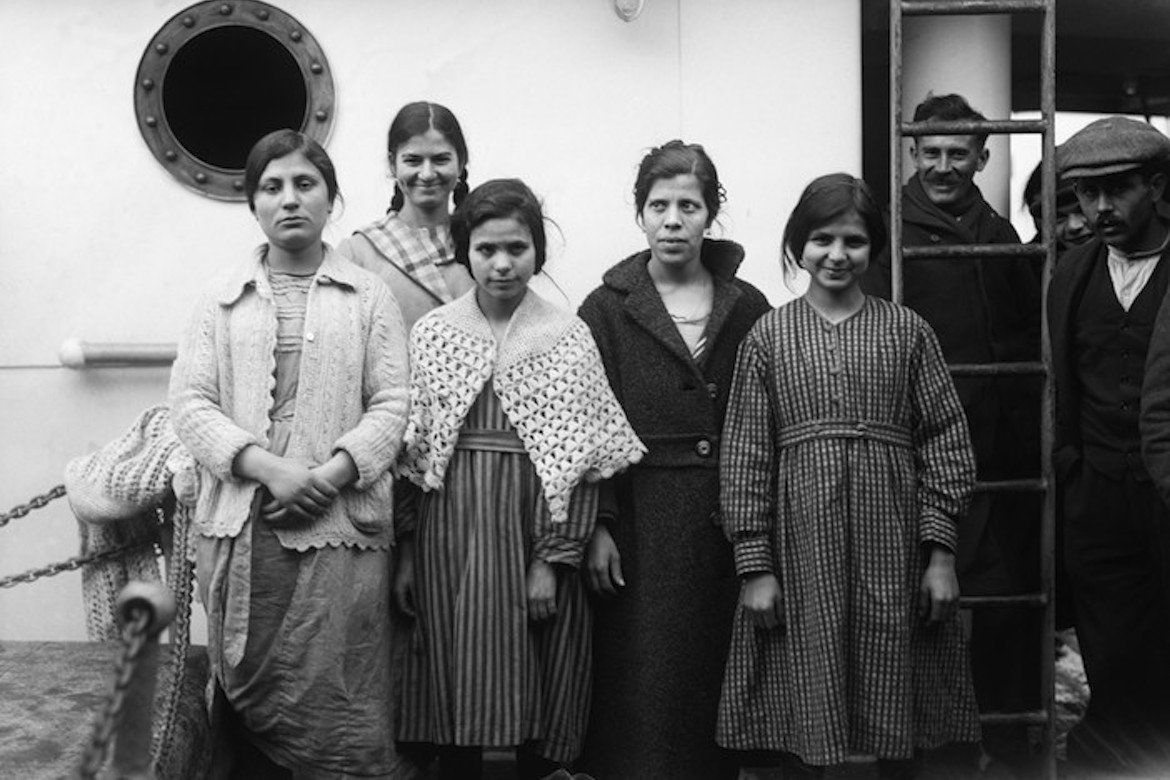
For the woman who arrived at Ellis Island as a picture bride, the moment of meeting was the pivot point of her life. She stepped off the ferry into the Great Hall carrying whatever she had been able to bring — an icon, a blanket woven on her village loom, the embroidered linens of her trousseau — and looked for a man who matched the photograph she had been given.
Sometimes the match was a good one. Sometimes the photograph had been taken twenty years earlier, or in borrowed clothes, or at an angle that concealed something the sender preferred to conceal. The woman had no recourse. She had crossed an ocean. Her family was far away. The marriage, in most cases, was legal before she arrived.
If the husband did not appear at all — which happened — the woman was detained at Ellis Island until her situation could be resolved, which sometimes meant deportation. The machinery of immigration did not make allowances for broken promises.
The AHEPA Trips
The picture bride system was supplemented, in the 1920s and 1930s, by a more organized approach. The American Hellenic Educational Progressive Association organized formal trips from its American chapters to Greece, where male members — wearing the AHEPA fez and what the villages considered strange western clothing — were introduced to eligible women in something resembling a group audition. Bands of village girls were lined up, in the accounts that survived, simultaneously eager and apprehensive, mocking the fez-wearing strangers from behind their hands.
A song entered Greek popular culture: "Den Ton Thelo ton Ahepa" — "I Don't Want the Ahepa Man" — which poked fun at the suitors and their fezzes and their inexplicable American habits. It was funny, and it was also a way of processing something that was not entirely funny: the displacement of courtship from the personal to the institutional, from the village to the transatlantic.
Race and Respectability
The picture bride practice was not perceived the same way across all immigrant groups. Japanese picture brides, who arrived on the West Coast in large numbers during the same period, were met with virulent hostility — exclusionists framed the practice as an immigration scheme, a threat to American racial purity, a form of disguised labor trafficking. The anti-Asian movements of the early century succeeded in pressuring Japan to stop issuing travel documents to picture brides by 1920.
Greek picture brides, by contrast, were treated in American newspapers with increasing sentiment as the century progressed — described as virtuous, civilizing influences on their rougher husbands, romanticized rather than threatened. Researcher Kathryn Vaggalis, who studied this disparity extensively, traced it to the shifting racial position of Greeks in American society. Greeks had been considered, in the early years of immigration, as "in-between" or probationary whites — Mediterranean, Orthodox, alien. As anti-Asian sentiment intensified and Greek-Americans worked to position themselves as unambiguously European, their picture brides were reframed accordingly. The same practice, in different hands, told a different story.
What They Built
The women who came to America as picture brides built, in most cases, exactly what they had been brought to build: families, households, communities. They learned English slowly or not at all, raised children who spoke both languages or only English, maintained the Orthodox faith in homes where an icon hung in every room, cooked the food of the villages they had left, and grew old in a country that had become, despite everything, theirs.
Calliope Tavoularis came from Athens to Nebraska in 1949 — late in the picture bride era — after exchanging letters with a man for a short time. He bought her a plane ticket. The local newspaper called their union an "airmail romance." She was one of the last of her kind, and also one of the thousands: women whose names are not in the history books, whose crossings are recorded only in ship manifests and church registers, and whose lives were the foundation on which the Greek-American community was built.
Sources: Pappas Post — "When Thousands of Greek Women Arrived as Picture Brides"; Kathryn Vaggalis, University of Kansas / American Studies Association Wise-Susman Prize research; Greek Reporter; Ellis Island Foundation records.