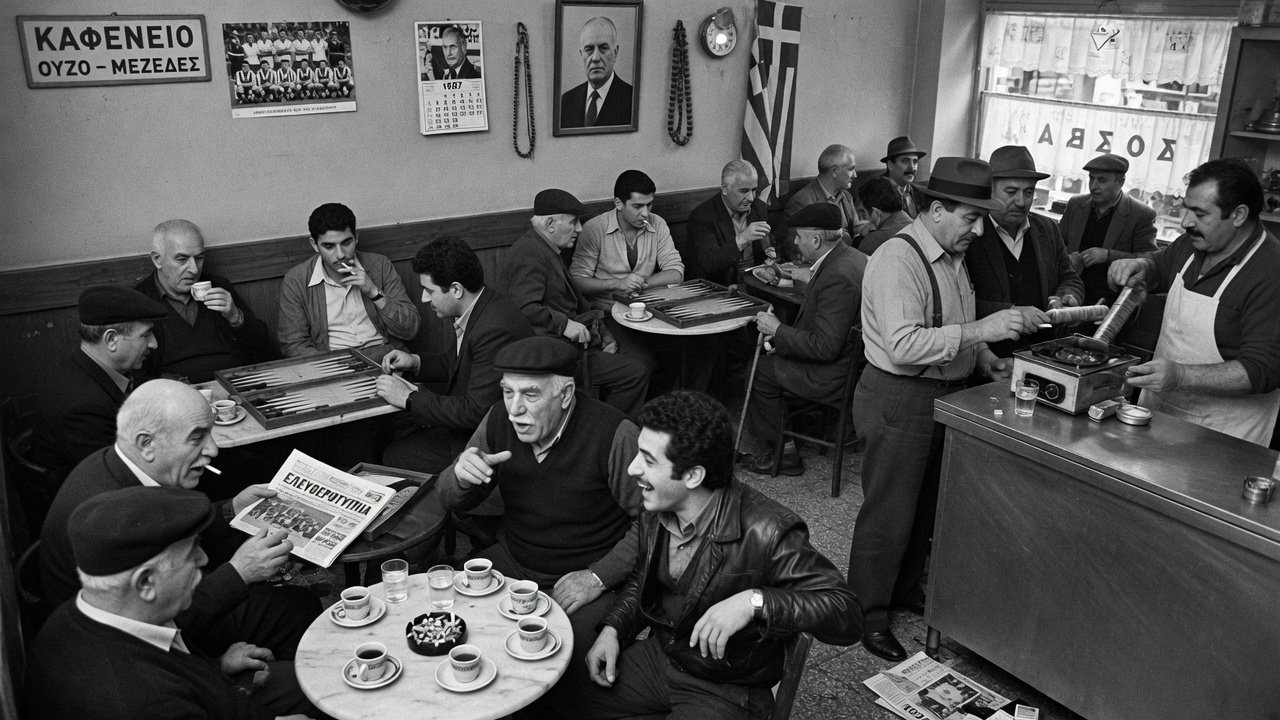
The Greek word is kafeneion. In the mining towns of Utah, in the tenement blocks of lower Manhattan, in the neighborhoods of Chicago and Pittsburgh and Lowell, it was simply called the coffeehouse. And in the early years of Greek settlement in America, it was the most important institution in the community — more immediately necessary than the church, more practically useful than any fraternal organization, and more honest about what the immigrants actually needed than any of the Americanization programs that were being designed for them by well-meaning outsiders.
What they needed, in the first instance, was each other.
What the Coffeehouse Was
The kafeneion in Greece was a men's social institution — a place to drink strong coffee, play cards or backgammon, argue about politics, and pass time in the company of other men. It was not a bar, though alcohol was sometimes served. It was not a restaurant, though food was sometimes available. It was a gathering place, and its essential function was the function of any gathering place: to make the people who used it feel less alone.
The Greek coffeehouse in America served all of these functions and several more. In a country where the immigrants spoke little English and understood less of the legal and commercial system they were navigating, the coffeehouse was an information exchange. Men who had arrived recently sat next to men who had been in America for years, and the information flowed in both directions — where the work was, what the labor agents were offering, which neighborhoods were safe, how to send money home, what a naturalization proceeding actually involved.
The Labor Market in the Coffeehouse
The padrones — the Greek labor agents who placed workers in the mines, on the railroads, and in the factories — worked the coffeehouses. They knew where to find concentrations of newly arrived men who needed work, and the coffeehouses were exactly those concentrations. The system was extractive: the padrone charged fees for placement, took a cut of wages, and in some cases controlled entire industries through his monopoly on the labor supply. But for the newly arrived immigrant with no English and no contacts, the padrone in the coffeehouse was often the only available path to employment.
By 1926, Portland, Oregon alone had several Greek coffeehouses serving a community of several hundred. Salt Lake City had its coffeehouses near the railroad yards. Carbon County, Utah had them in every mining town. Wherever Greeks worked in significant numbers, within months of their arrival, someone had opened a coffeehouse.
Politics Across the Atlantic
The coffeehouses were also where Greek politics crossed the ocean. The great National Schism of the World War I era — the division between the royalist supporters of King Constantine and the republican followers of Prime Minister Venizelos — divided Greek-American communities as bitterly as it divided Greece itself. Men who had been sitting together in the same coffeehouse for years stopped speaking to each other. In some cities, rival coffeehouses were established on the same street, one for royalists and one for Venizelists, and neither camp would enter the other's establishment.
This was not simply political passion imported from the old country. It was also a question of identity — of what kind of Greek one was and what kind of Greek-American one intended to become. The coffeehouse, which was supposed to be the place where the community held together, became in this period a place where the community's divisions were most visibly displayed.
What Came After
As the Greek-American community matured, the coffeehouse gradually gave way to other institutions. The church became more stable and more central. Fraternal organizations — AHEPA, GAPA, and the regional lodges — provided some of the social functions the coffeehouse had served. The second generation, American-born and American-educated, did not feel the same pull toward the kafeneion that their fathers had.
But the institution left its mark. The coffeehouses were where the community's leadership formed, where the arguments that shaped the community's direction were had, and where the information that made survival possible was exchanged. They were imperfect institutions — exclusive to men, vulnerable to the exploitative padrone networks that worked them, capable of dividing as well as uniting. But in the first years of Greek settlement in America, they were indispensable. Before there was a community, there was a coffeehouse. The community grew around it.
Sources: Thomas Burgess, "Greeks in America" (Boston: Sherman, French & Company, 1913). Public domain. Helen Zeese Papanikolas, "Toil and Rage in a New Land: The Greek Immigrants in Utah" (Utah Historical Society, 1970). Oregon Encyclopedia — "Greek Community in Oregon." Hellenic-American Cultural Center and Museum Oral History Project.