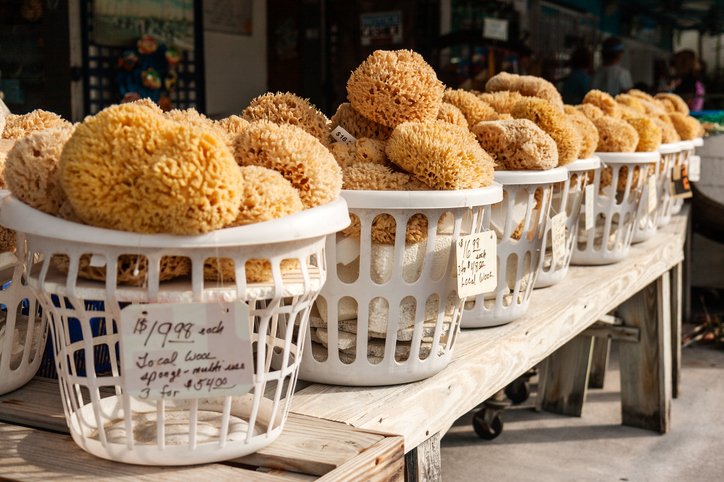
In the summer of 1905, a Greek sponge merchant named John Cocoris stood on the docks at Tarpon Springs, Florida, and looked out at the waters of the Gulf of Mexico. Cocoris had come from the Dodecanese island of Hydra, and he had come for a reason: the sponge beds off the Florida coast were among the richest in the world, but they were being harvested inefficiently, by men wading in shallow water with long-handled hooks. Cocoris knew a better way. He had grown up watching Aegean divers descend in hard-hat diving suits to depths that hook fishermen could never reach. He believed that those same techniques, applied to the Florida beds, could transform the industry.
He was right. And the transformation he set in motion would bring more than a thousand Greek immigrants from the Dodecanese to this small town on the Gulf Coast, creating a community so complete, so rooted, and so specifically Greek that it remains — more than a century later — unlike anywhere else in America.
From the Aegean to the Gulf
The Greeks who came to Tarpon Springs were not random immigrants drawn from the general pool of Mediterranean labor. They were specialists, men from the sponge-diving villages of the Dodecanese — particularly Kalymnos, Symi, and Halki — who had practiced this dangerous trade for generations. Sponge diving was a hereditary craft, passed from father to son, inseparable from the culture and economy of those islands. When Cocoris sent word back to the Dodecanese that there was work in Florida, he was not merely offering employment. He was transplanting an entire occupational culture.
The divers who arrived between 1905 and 1910 brought their equipment — the bulky copper helmets and rubberized suits of the hard-hat diving system — their knowledge, their social hierarchies, and their families. They brought their priests and their language. They brought their Orthodox faith, which was not merely a religion but a framework for the entire calendar of life, from the blessing of the sponge boats at Epiphany to the fasting cycles that structured the year. They built St. Nicholas Greek Orthodox Cathedral, whose white dome became the visual center of the community, and they organized their social life around the church with the same totality that their ancestors had in the Dodecanese.
The industry they built was remarkable. By the 1930s, Tarpon Springs was the largest sponge-fishing port in the United States, processing more sponges than any other city in the world. The Dodecanese Greeks had not merely improved the existing industry; they had remade it in their own image. The sponge exchange on Dodecanese Boulevard — named for the island chain that supplied its workforce — was the commercial heart of a trade that employed hundreds of divers, boat captains, and processing workers and supported an entire economy of Greek-owned businesses.
The Bends and the Sea
The work was lethal. Decompression sickness — known to divers as the bends — killed and crippled men who ascended too quickly from depth. The compressed air of the diving suits was a technology that the industry was still learning to manage safely, and the learning came at an appalling human cost. In the early years, it was common for a boat to return to Tarpon Springs with men paralyzed, unable to walk, their joints and spines damaged by nitrogen bubbles that had formed in their blood during rapid ascent.
The community developed rituals and practices around this danger. The blessing of the fleet at Epiphany — when the archbishop or a priest threw a white cross into the waters of Spring Bayou and young men dove to retrieve it — was not merely a religious ceremony but an acknowledgment of the sea's power and a prayer for protection. The families of divers understood that each season's departure might be final. The cemeteries of Tarpon Springs contain the graves of young men who never came back from the Gulf, their headstones bearing the carved images of diving suits and sponge boats.
A Community Sealed Against Time
What made Tarpon Springs unusual among Greek-American communities was the degree to which it resisted assimilation. In Chicago and New York, the pressure to Americanize was intense and largely irresistible; within two generations, most Greeks had moved to the suburbs, adopted English as their primary language, and participated in the broader American culture. Tarpon Springs was different. The community was small enough and cohesive enough to maintain its own norms. The Greek language remained in active use not just in church and home but in commerce and public life. Intermarriage with non-Greeks was relatively rare through the mid-twentieth century. The community reproduced its own leadership from within.
This insularity was reinforced by the nature of the sponge industry, which required trust networks that were easiest to maintain within the community. A boat captain needed a crew he could rely on in dangerous conditions; a merchant needed suppliers and buyers whose word he could take. The Greek community of Tarpon Springs was also a business network, and the social cohesion that maintained it served an economic function as well as a cultural one.
The Blight and After
In 1947, a fungal blight devastated the Florida sponge beds, destroying the natural sponge industry almost overnight. The economic blow to Tarpon Springs was severe. Many families left. Others pivoted to fishing, to tourism, or to work in the broader Tampa Bay economy. The sponge exchange continued to operate but at a fraction of its former volume.
The response of the community to this crisis reveals something important about its character. Rather than dissolving, the Greeks of Tarpon Springs transformed their identity into an asset. The waterfront — the Sponge Docks district on Dodecanese Boulevard — became a tourist destination, trading on the authenticity of its Greek character. Restaurants serving Greek food, shops selling sponges and Greek imports, and the visible presence of a working fishing community attracted visitors from across Florida and beyond.
This was not cynical. The community was genuinely still Greek, still Orthodox, still speaking the language of the Dodecanese. Tourism did not invent the authenticity of Tarpon Springs; it monetized what was already there.
Tarpon Springs Today
Today Tarpon Springs is the most visited city per capita in Florida, a distinction built almost entirely on its Greek identity. The Sponge Docks draw hundreds of thousands of visitors each year, who come to eat loukoumades and souvlaki, to buy sponges from boats that still go out to the Gulf, and to watch the Epiphany ceremony — which remains one of the largest Greek Orthodox celebrations in the United States, drawing the Archbishop of America and thousands of pilgrims each January.
The community itself has changed. The fourth and fifth generations are thoroughly American in their daily lives, their educations, and their professional paths. But the institutions that their great-grandparents built — the cathedral, the schools, the cultural festivals, the commitment to Greek language instruction — are still functioning. The sponge boats that remain are operated by families whose connection to the Dodecanese diving tradition goes back more than a century.
No other Greek community in America has maintained this degree of continuity with its origins. Tarpon Springs is the closest thing the Greek-American experience has to a living museum — not a reconstruction, but a place where the original act of community-building has never entirely stopped.