In the early years of the twentieth century, a young man from a village in the Peloponnese or from the hills of Crete had a limited set of futures available to him. He could farm exhausted land. He could serve in the Greek army. He could wait. Or, if someone in his village had already gone, if a letter had arrived with a few American dollars folded inside, he could go to America.
Most of them intended to come back.
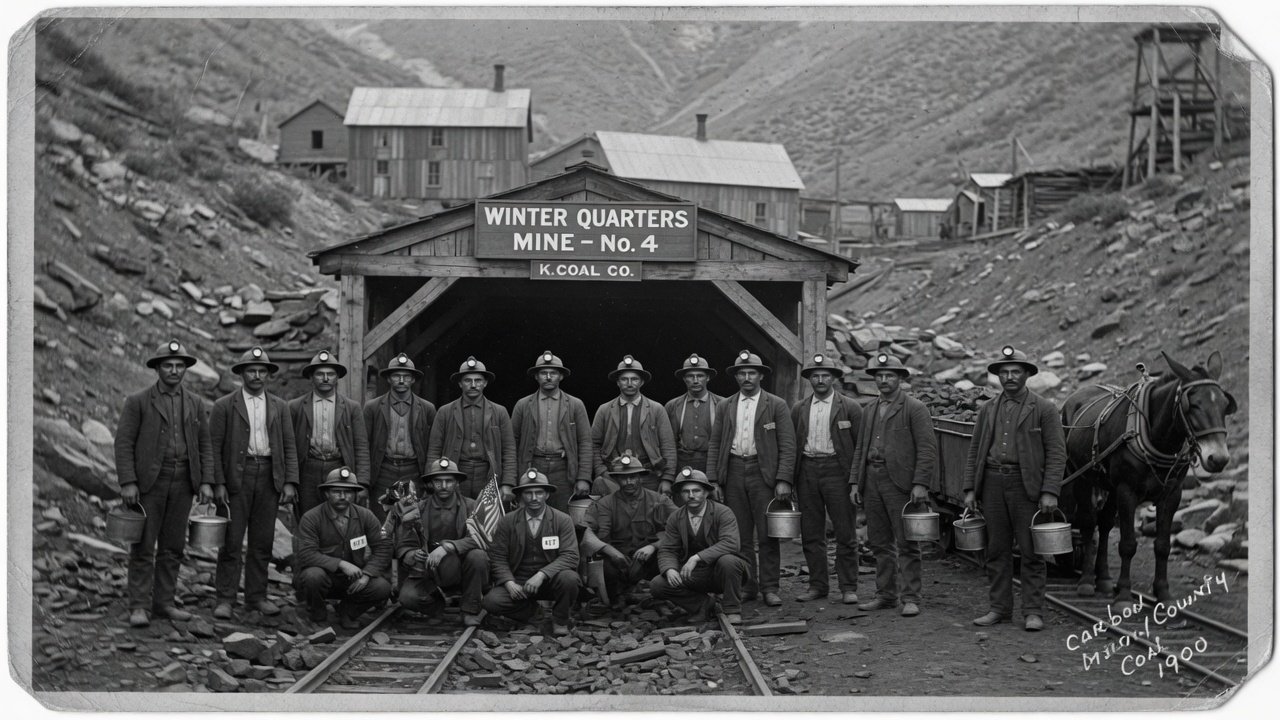
They crossed the Atlantic in steerage, arrived at Ellis Island, and made their way through the streets of New York looking for someone — anyone — who spoke Greek. From the city they followed the labor networks west: Chicago, Denver, Salt Lake City. By 1905, thousands of Greek men had settled in Utah, concentrated around the railroad yards, the copper mines, and, increasingly, the coal seams of Carbon County.
The Man Who Opened the Door
The story of Greeks in Utah begins, in a practical sense, with a single man. Leonidas Skliris had come to America earlier than most, had learned railroad construction on a Midwestern gang, and had recognized an opportunity. The railroads needed cheap labor for branch line extensions. The coal mines of Carbon County needed men to work new veins as they were constantly opened. The copper operation at Bingham Canyon was expanding at a pace that American labor could not keep up with.
Skliris became what was known as a padrone — a labor agent — and his reach extended throughout the Midwest and West. Greek immigrants who wanted to work in Utah had to go through him. They were required to present notes from his Salt Lake City office. And for that service, Skliris charged an upfront fee of between twenty and fifty dollars — an enormous sum for a man who had just arrived with nothing — plus an additional dollar deducted from his wages every month. A portion of those fees went directly to the mine bosses who gave Skliris his contracts.
He was known, with bitter accuracy, as the Czar of the Greeks.
Underground
The work itself was brutal. The Greek men who went to Carbon County found themselves in mining towns that could not spread outward and so grew upward along mountain slopes — crowded, loud, combustible places where a dozen nationalities lived in enforced proximity. Germans, Poles, Yugoslavs, Italians, Armenians, Syrians, Japanese, and Greeks all worked the same tunnels and breathed the same coal dust.
Their wages were lower than those of American workers. They were assigned the more dangerous tasks. They were prohibited from living in or purchasing property in certain neighborhoods. The general population, which had not expected the sudden arrival of hundreds of dark-complexioned single men with strange customs and an incomprehensible language, was openly hostile. Nativist newspapers ran editorials about the threat of the southern European. In at least two recorded instances, Greek men were nearly lynched — one in Salt Lake City, another in Carbon County for the offense of giving an American woman a ride in his new automobile.
And still they came, because the alternative was poverty and the wages, dangerous as they were, were real.
The Church and the Kitchen
The Greek community in Utah did what Greek communities everywhere in America did: it built a church. In 1905, the Salt Lake City congregation raised enough money to construct a church dedicated to the Holy Trinity — the first thing they built together. It would not be the last.
The church served a function that went beyond liturgy. In a place where young men died regularly in mine collapses, smelter accidents, and railroad incidents — one hundred and fifty-three Greeks were killed in Utah between 1907 and 1960 — the church was where the dead were brought. The community also cultivated its own healers: women, often wives who had come later as picture brides. One such woman, called Magherou by those who sought her out, was known throughout the entire Intermountain West.
The women baked bread in outdoor domed earth ovens. They planted vegetable gardens and watered them with Utah's irrigation canals. They ran boardinghouses, raised children, delivered babies for neighbors. The neighborhoods they built in the mining towns functioned, by design, like transplanted Greek villages — familiar foods, familiar saints' days, familiar sounds.
The Strike
By 1912, the tension that had been building since the first Greeks arrived finally came to a head. The Western Federation of Miners called a strike at the Utah Copper mine in Bingham Canyon. Of the thousands of men who worked there, twelve hundred were Greek.
The union understood that it could not win without bringing the Greeks in. The Greeks understood that they had their own reason to strike: not wages alone, but Leonidas Skliris. His system of fees and kickbacks had extracted money from them for years. They joined the strike with that demand foregrounded — remove Skliris, or there would be no end to it. The strike itself was eventually broken. But Skliris was forced out. It was not a clean victory, but it was a real one.
Castle Gate
On March 8, 1924, the Number Two mine at Castle Gate exploded. One hundred and seventy-one men were killed. Forty-nine of them were Greek. They left behind forty-one children.
The Greek towns of Carbon County entered a period of grief unlike anything they had experienced. Women keened beside the coffins. The church in Price could not hold all of the funerals. Families had come to Utah expecting the men to return to Greece with their savings. Some of those men were now gone, and the women were in a foreign country with children who had been born on foreign soil, and the question of home had become permanently complicated.
The Klan and the Response
In 1923 and 1924, the Ku Klux Klan ran active campaigns in Utah. They burned crosses in Salt Lake City and in the industrial towns. They marched through streets, sent threatening letters to Greek business owners, and raided Greek-owned shops in Helper, driving out American employees and warning them not to work for Greeks.
The Greek community, together with the Catholic Knights of Columbus and other immigrant groups, organized in response. The Klan lost ground in Utah faster than in many other places. But the episode made clear to the Greeks what their status was in the eyes of a significant portion of the American population: not quite welcome, not quite white, not quite American.
What They Left
The Great Depression hit Carbon County hard. Many Greeks left for California. Others held on with savings that old-country frugality had helped them accumulate. The 1940 census counted roughly the same number of Greeks in Utah as the 1910 census — the Depression had erased three decades of growth — but by then the American-born children of the original immigrants numbered in the thousands.
Those children grew up between worlds. They spoke Greek at home and English at school. They danced at the great feast-day celebrations and played American sports. They went into the American military during World War II — 440 from the Salt Lake congregation alone, 125 from Carbon County, twenty-two of whom did not come home.
The men who had come from the Peloponnese and Crete and the Aegean islands to dig coal and lay railroad tracks had not intended to plant a community. They had intended to earn money and return. But the community took root anyway — not as a plan, but as a consequence of living.
Sources: Helen Zeese Papanikolas, "Toil and Rage in a New Land: The Greek Immigrants in Utah" (1970); Utah History Encyclopedia; Utah History to Go, Utah Historical Society.