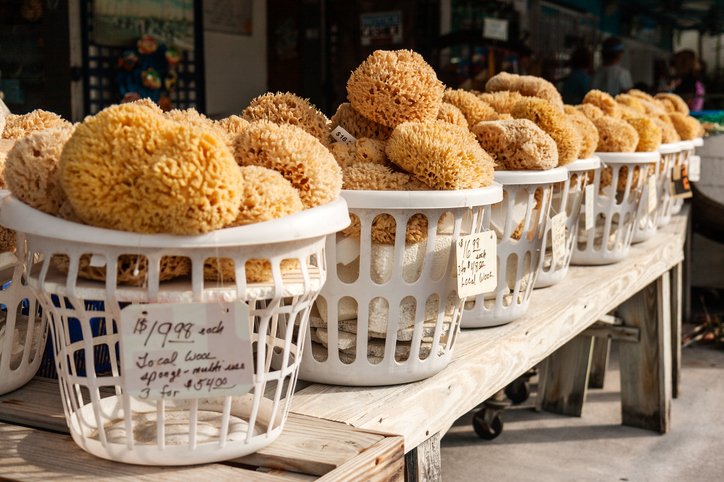
There is a stretch of coast along the Gulf of Mexico in Pinellas County, Florida where the streets have names like Dodecanese Boulevard and the high school sports teams are called the Spongers. The largest building in the city is a Greek Orthodox cathedral modeled after the Hagia Sophia in Constantinople. On the sixth of January every year, thousands of people gather at the waterfront to watch young men dive into the chilly bay for a cross thrown by a priest — a ceremony that has been performed on this spot for over a century.
The city is Tarpon Springs. And none of it would exist the way it does without the men who came from a cluster of Greek islands in the eastern Aegean and brought with them a skill perfected over generations: the art of finding sponges on the floor of the sea.
The Island Trade
Long before they came to Florida, the men of the Dodecanese Islands — dodeca meaning twelve in Greek, nese meaning island — made their living from the sea. The islands of Kalymnos, Symi, and Halki had developed a sponge-diving tradition that stretched back centuries. In the earliest days, before any equipment existed, the divers worked on a single breath. The most skilled among them could descend to depths of a hundred feet and remain submerged for several minutes. They used flat stones as weights to carry them down faster.
The work was dangerous in ways that were simply accepted as part of the trade. Divers surfaced too quickly and were left partially paralyzed by decompression sickness — nitrogen bubbles forming in the blood. Men were crippled, and men died. The islands held a particular kind of grief, a community built around the sea and regularly reminded of its price.
As diving technology advanced through the nineteenth century, the islands adapted. The Greeks called the new full-body rubberized suit the Skafandro. With a copper and brass helmet connected by an air hose to the surface, a diver could now go deeper and stay longer. Kalymnos became the center of deep-water sponge diving in the Mediterranean. The knowledge lived in families, passed from fathers to sons, generation by generation.
John Cocoris and the Crossing
In the late 1890s, a Greek sponge trader named John Michael Cocoris arrived in Tarpon Springs, a small Florida town where an American entrepreneur named John Cheyney had been trying to build a sponge business using primitive hook-and-bucket methods. Cocoris, who had come from the Peloponnese and was working in the New York sponge trade, recognized immediately what the Gulf waters held and what was needed to reach it.
He returned to Greece and recruited.
In 1905, Cocoris brought back a contingent of experienced divers from the Dodecanese — along with their rubberized suits, their copper helmets, their air lines, and their knowledge. On June 18 of that year, a diver was lowered over the side of a boat and walked for the first time on the floor of the Gulf of Mexico. Within the decade, the floor of the Gulf off Tarpon Springs would be as well-known to Kalymnian divers as the floor of the Aegean had been to their fathers.
The Gold Rush
The word spread quickly back to the islands. In 1906, over fifteen hundred divers and sponge workers crossed the Atlantic and came to Tarpon Springs. They brought families, or sent for them. They built houses, opened coffeehouses and restaurants and grocery stores that sold olive oil, salted fish, and Greek tobacco. In 1907 they founded the Sponge Exchange — a non-profit organization of fifty local buyers that provided storage and conducted silent auctions of the harvest.
George Billiris, whose family arrived in 1904 and whose grandfather, father, and uncle all worked the docks, described it later as being like a gold rush. For a time, sponges exceeded Florida's citrus crop as the state's leading export. Tarpon Springs became known, without exaggeration, as the Sponge Capital of the World.
The divers themselves were gone for weeks at a time — sometimes a full two months — working the Gulf beds. The suit alone was an ordeal: lead-weighted wooden shoes at twelve pounds each, two layers of canvas over a layer of rubber, a copper and brass collar connecting to a helmet that weighed thirty-eight pounds. A diver descended to the seafloor in roughly ninety pounds of equipment, worked by feel and by what he could see through the small circular glass of the helmet, and was raised back up when he signaled the surface crew by tugging on his air line.
Faith on the Water
The divers brought their faith with them as surely as they brought their equipment. The community built St. Nicholas Greek Orthodox Cathedral — named for the patron saint of sailors — on Pinellas Avenue. Modeled on St. Sophia in Constantinople, it became and remains the spiritual center of the community.
The feast of the Epiphany, celebrated on January 6 each year, became the most important public ceremony in Tarpon Springs. The Greek Orthodox Archbishop blesses the waters, a crucifix is thrown into Spring Bayou, and young men dive in to retrieve it. The one who surfaces with the cross is said to receive a year of good fortune. The tradition was observed in the islands before anyone came to Florida. It is observed in Tarpon Springs still, drawing thousands of visitors every year.
The blessing mattered to the diving families in a particular way. The Gulf was not a friendly employer. Divers suffered the bends. Equipment failed. Men did not always return. The annual blessing of the waters was not merely ceremony — it was a negotiation with the sea, conducted in the only language that the sea had ever understood.
Red Tide and Ruin
For three decades, Tarpon Springs dominated the global sponge trade. Then, in 1938, disaster arrived in the form of a red tide — a harmful algal bloom that swept through the Gulf and decimated the sponge beds. By the 1940s the sponge industry had effectively collapsed, and many of the diving boats converted to shrimping.
But the community did not collapse with it. The Greeks of Tarpon Springs had by then planted themselves too deeply. The restaurants stayed open. The cathedral held its services. The Epiphany was celebrated. Tourism, which the sponge industry had inadvertently created, became the new economic backbone.
In the late 1970s, the sponge beds began to recover. In the 1980s, a sponge disease that devastated the Mediterranean crop drove renewed demand for Florida sponges, and Tarpon Springs reclaimed its title. A smaller but thriving sponge industry operates there today.
What Remains
In 2007 and 2008, the city of Tarpon Springs established sister-city relationships with Kalymnos, Halki, Symi, and Larnaca, Cyprus — a formal acknowledgment of the thread that still connects this corner of Florida to the islands that sent its founders. The downtown and Sponge Docks were designated the Tarpon Springs Greektown Historic District by the National Register of Historic Places in 2014.
Census figures show that more than one in ten residents of Tarpon Springs today claim Greek descent — a higher proportion than any other American city. More than seven percent report speaking Greek in their homes.
The men who came from Kalymnos and Symi and Halki carrying rubber suits and copper helmets did not come to build a city. They came to find sponges. The city was what happens when people bring everything they are to a new place and simply refuse to leave.
Sources: Tarpon Springs Area Historical Society; University of Florida Digital Collections; Visit Florida; Hellenic News of America; Wikipedia — Tarpon Springs.